Important changes to the UK Immigration Rules take effect on 8 October 2026, affecting how fee-waiver requests interact with subsequent immigration applications and biometric enrolment.
For applicants who rely on a fee waiver because they cannot afford Home Office application fees, careful preparation will become even more important.
The changes were introduced through the Statement of Changes to the Immigration Rules HC 584, published by the Home Office on 3 September 2026. They amend paragraph 34G(4) and introduce a new paragraph 34BB(2A).
The key message is simple:
From 8 October 2026, applicants need to be clear about their intended immigration route from the beginning and must not assume that changing an application will give them additional time to enrol their biometrics.
For genuine applicants, fee waivers remain available. However, the revised rules reduce the scope for using a fee-waiver request or application variation as a way of extending immigration protection while pursuing a different route.
What is a Home Office fee waiver?
A fee waiver allows certain eligible applicants who cannot afford the relevant Home Office fees to ask for all or part of those fees to be waived.
Applicants normally need to provide evidence about their financial circumstances. This may include:
- bank statements;
- household income;
- payslips;
- evidence of benefits or public funds where applicable;
- rent and essential household expenditure;
- financial support received from relatives, local authorities or other organisations; and
- information about savings or other available resources.
The Home Office’s current public guidance states that applicants using the fee-waiver service may need to provide evidence of household earnings, expenses and financial support.
If a fee waiver is approved, the applicant receives a personalised fee-waiver code or token. The Home Office currently requires the applicant to use that code to submit the relevant visa application within 10 working days of receiving the decision.
The applicant must also comply with the biometric requirements. Current Home Office guidance says an applicant who is required to book an appointment must attend within the relevant timeframe after being asked to do so.
What is Section 3C leave and why does it matter?
Section 3C of the Immigration Act 1971 can extend a person’s existing immigration leave while a valid in-time application is being decided.
This is extremely important because an applicant whose previous permission expires while an eligible application is pending may, subject to the applicable rules and circumstances, continue to have lawful status under Section 3C.
In the fee-waiver context, timing is crucial.
Home Office fee-waiver guidance states that an applicant can benefit from Section 3C leave where they had valid permission when the fee-waiver request was submitted, that permission expires while the fee-waiver request is being considered, and they subsequently make the required valid application within the prescribed period.
The application submitted must also be the application for which the fee-waiver request was made.
Failing to satisfy the relevant requirements can therefore have serious immigration consequences.
What changes on 8 October 2026?
There are two particularly important changes.
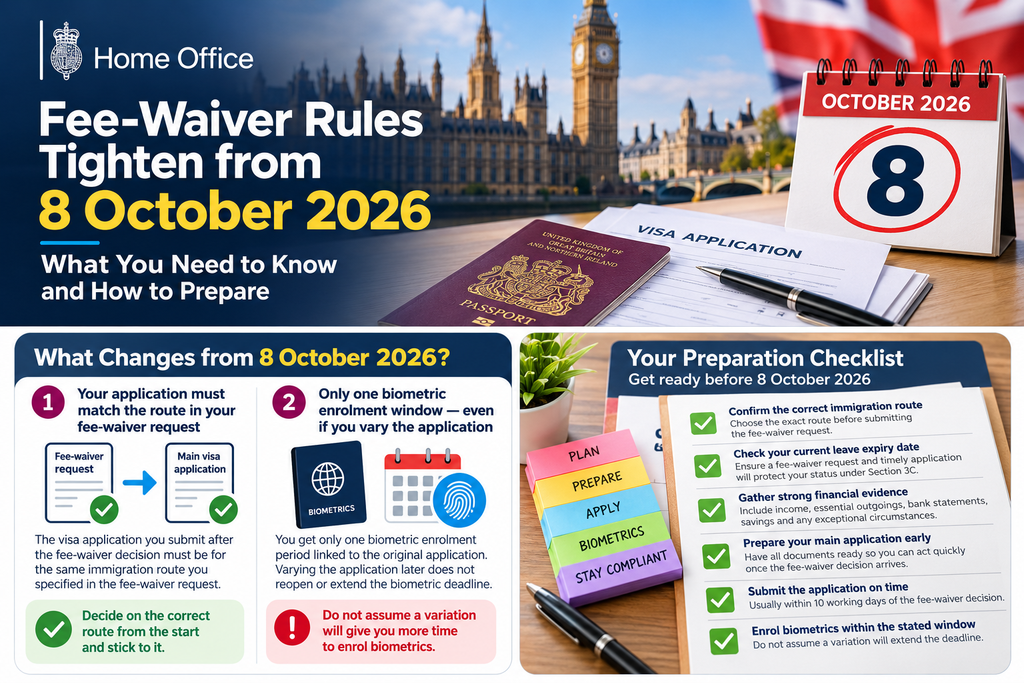
1. Your subsequent immigration application must match the route in your fee-waiver request
The revised paragraph 34G(4) makes route consistency explicit.
Where an online immigration application follows a fee-waiver request, the earlier date of the fee-waiver request can be treated as the application date only where the required conditions are satisfied.
Crucially, the completed application for permission to stay must be for the route for which the fee-waiver request was made.
It must also normally be submitted within 10 working days of receiving the fee-waiver decision.
This means applicants should not submit a fee-waiver request naming one immigration route while intending to make a completely different application afterwards.
Why does this matter?
Previously, questions had arisen around whether an applicant could submit a fee-waiver request connected with one type of application and later pursue another route while seeking to rely on the earlier date.
The Home Office explanatory memorandum accompanying HC 584 makes the policy intention particularly clear.
The Government says the amendment is intended to confirm that the application following a fee-waiver decision must be the application specified in the fee-waiver request.
The Home Office says the change is intended to combat abuse involving applicants seeking to extend their permission under Section 3C by making a human-rights application and subsequently varying it to a non-human-rights application.
For applicants, the practical lesson is straightforward:
Choose the correct immigration route before submitting the fee-waiver request.
If there is genuine uncertainty over which route is appropriate, obtaining regulated immigration advice before proceeding may be particularly important.
2. Varying an application does not restart the biometric deadline
The second major change concerns biometrics.
A new paragraph 34BB(2A) provides that where an applicant varies a previous application, they must still comply with the biometric submission period that applied to the previous application for the application to remain valid.
In practical terms:
Changing or varying an application does not give the applicant a fresh biometric enrolment period.
This is an important point because applicants should not assume that submitting another application or varying an existing application resets the clock.
The Home Office explanatory memorandum states that this amendment confirms existing policy and is intended to prevent applicants from making an application, failing to enrol biometrics and then varying the application repeatedly.
The safest approach
Once biometric instructions are issued:
- Read the instructions immediately.
- Record the deadline.
- Book any required appointment as soon as possible.
- Do not rely on an application variation to extend the deadline.
- Keep evidence of the booking and biometric enrolment.
Why is the Home Office making these changes?
According to the explanatory memorandum accompanying HC 584, the amendments are specifically intended to address misuse of the existing system.
However, this does not mean genuine fee-waiver applicants are being prevented from accessing the system.
Eligible applicants can continue to request fee waivers.
What changes is the level of flexibility surrounding what happens afterwards.
The new rules place greater emphasis on three things:
Consistency. The immigration route identified when requesting the fee waiver should match the subsequent application.
Timing. The main application must be submitted within the required timeframe.
Biometrics. Applicants must comply with the original biometric deadline even if an application is subsequently varied.
What about applications made before 8 October 2026?
HC 584 contains an important transitional provision.
For the relevant changes, where an application for entry clearance, permission to enter, permission to stay, a claim or an application for administrative review was made before 8 October 2026, it will generally be decided under the Immigration Rules that were in force on 7 October 2026.
Anyone with a case spanning the changeover date should nevertheless check carefully which rules apply to their individual circumstances.
Do not assume that a case falls under the previous rules simply because some preparatory action took place before 8 October.
Who should pay particular attention?
The changes are especially relevant to:
- people considering making a fee-waiver request;
- applicants whose current immigration permission is approaching expiry;
- people relying or expecting to rely on Section 3C leave;
- applicants considering changing immigration routes;
- immigration advisers managing fee-waiver cases;
- organisations supporting vulnerable applicants; and
- employers whose workers may be navigating an extension or change to their immigration permission.
For the health and social care sector, employers should remember that immigration status and right-to-work compliance can intersect.
Employers should not attempt to give employees personal immigration advice unless appropriately authorised to do so. Where an employee has a complicated immigration situation, they should be encouraged to seek advice from a suitably regulated immigration adviser or solicitor.
Practical preparation checklist
If you or someone you support is considering a fee-waiver request, preparation should begin before the request is submitted.
Before requesting the fee waiver
Confirm the intended immigration route.
Determine precisely which route the applicant intends to use. Do not choose a route merely as a temporary mechanism for gaining more time.
Check the current permission expiry date.
Establish exactly when existing leave expires and obtain professional advice where necessary about whether Section 3C may apply.
Prepare financial evidence.
Gather the evidence needed to demonstrate why the applicant cannot afford the relevant fees.
This might include bank statements, payslips, rent evidence, household expenditure and evidence of financial support.
Prepare the main immigration application early.
Do not wait until the fee-waiver decision arrives before beginning the substantive application.
The post-decision period can be short.
Once the fee-waiver decision arrives
Act immediately.
Record:
- the date the decision was received;
- the 10-working-day deadline;
- the application route;
- the fee-waiver reference or token;
- any biometric instructions;
- biometric appointment dates; and
- confirmation that the substantive application was submitted.
Remember that weekends and bank holidays are not counted as working days for the relevant 10-working-day period.
A simple example
Consider an applicant whose existing immigration permission is close to expiry.
The applicant intends to make an eligible family or private-life application and needs a fee waiver.
They submit their fee-waiver request while they still hold valid permission.
Once the Home Office makes its decision, the applicant submits the matching immigration application within the required timeframe and complies with the biometric requirements.
That is very different from submitting a fee-waiver request for one route and later deciding to use the request as the basis for an unrelated immigration route.
From 8 October, paragraph 34G(4) expressly requires the subsequent application to be for the route for which the waiver request was made if the applicant is to rely on the fee-waiver request date under that provision.
What should applicants avoid?
There are four particularly important mistakes to avoid.
Do not treat a fee-waiver request as a general immigration “pause button”.
A fee waiver exists to assist eligible applicants who genuinely cannot afford the relevant fees.
Do not name one immigration route while planning to pursue another.
Route consistency is now expressly built into paragraph 34G(4).
Do not miss the 10-working-day window.
Where that requirement applies, failing to submit the required application on time can have serious consequences.
Do not assume an application variation gives you a new biometric deadline.
Under new paragraph 34BB(2A), the applicant remains subject to the biometric period linked to the previous application.
What should care providers and employers know?
Care providers are not responsible for managing an employee’s personal immigration application, but these changes are worth understanding because immigration status can have consequences for right-to-work compliance.
If a sponsored or migrant worker tells an employer that their existing visa has expired but a further application is pending, the employer should follow the appropriate Home Office right-to-work checking process rather than making assumptions about the worker’s status.
Where necessary, employers may need to use the Home Office’s relevant verification processes.
HR and compliance teams should maintain accurate records and distinguish between:
- immigration advice for the individual;
- sponsorship responsibilities;
- right-to-work checks; and
- employment decisions.
These are related issues, but they are not the same thing.
Frequently Asked Questions
When do the new Home Office fee-waiver rules take effect?
The relevant amendments to paragraphs 34G and 34BB take effect on 8 October 2026.
Is the Home Office abolishing fee waivers?
No. These changes do not abolish the fee-waiver system. Eligible applicants can continue to request a fee waiver.
How long do I have to apply after receiving a fee-waiver decision?
Home Office guidance states that where the relevant process applies, the visa application must be submitted within 10 working days of receiving the fee-waiver decision.
Can I request a fee waiver for one route and then apply under another?
From 8 October 2026, paragraph 34G(4) expressly requires the subsequent application to be for the route for which the fee-waiver request was made if the applicant wishes the application date to be treated as the date of the fee-waiver request under that provision.
Changing routes can therefore have significant consequences and professional advice should be sought where necessary.
Does varying my application restart my biometric deadline?
No. New paragraph 34BB(2A) makes clear that an applicant who varies an application must still comply with the biometric submission period applying to the previous application.
What happens if I miss the deadline after my fee-waiver decision?
Missing the required application deadline may mean the applicant cannot rely on the fee-waiver request date in the expected way and can have serious implications for immigration status and Section 3C protection.
Anyone who has missed a deadline should obtain regulated immigration advice promptly rather than attempting to correct the situation without advice.
Does a fee-waiver request automatically give me Section 3C leave?
Not simply by itself in every circumstance.
The interaction between a fee-waiver request, the subsequent valid immigration application, the timing of existing permission and Section 3C is technical. Home Office guidance sets conditions that must be satisfied, including making the appropriate application within the required timeframe.
What happens to applications submitted before 8 October?
HC 584 provides transitional arrangements for the relevant amendments. Applications made before 8 October 2026 falling within those provisions are generally decided under the Immigration Rules in force on 7 October 2026.
Final Takeaway
The Home Office fee-waiver changes taking effect on 8 October 2026 make preparation, consistency and timing more important than ever.
The central principle is straightforward:
Know your immigration route before requesting a fee waiver, submit the corresponding application on time, and comply with the original biometric deadline.
A fee-waiver request should never be treated simply as a mechanism for buying additional time.
Applicants whose permission is close to expiry, whose circumstances could require a different immigration route, or who are unsure whether Section 3C protects them should seek regulated immigration advice before taking action.
For care providers and other employers, the safest approach is equally clear: maintain robust right-to-work procedures, avoid giving unregulated personal immigration advice and refer complicated cases to appropriately qualified professionals.
Important disclaimer: This article provides general information and does not constitute immigration or legal advice. Immigration cases depend on individual circumstances and the Immigration Rules and Home Office guidance can change. Anyone unsure about their position should seek advice from a suitably regulated immigration adviser or solicitor.