Everything you need to know about free contraception, where to get it, and how to choose the right method.
Making decisions about your sexual and reproductive health can feel overwhelming, especially if you’re unsure where to start. The good news is that contraception is widely available free of charge through the NHS, and many services do not require a prescription.
Whether you’re 18 and thinking about contraception for the first time, starting a new relationship, planning your future, or simply looking for reliable information, this guide explains everything you need to know in clear and simple language.
What Is Contraception?
Contraception is the name given to methods that help prevent pregnancy. Some methods also protect against sexually transmitted infections (STIs), while others only prevent pregnancy.
There isn’t a “best” contraceptive for everyone. The right choice depends on your health, lifestyle, future plans and personal preference. That’s why NHS healthcare professionals are available to provide confidential advice and help you choose the method that works best for you.
Types of Contraception
There are several different types of contraception available through the NHS.
Barrier Methods
Barrier methods stop sperm from reaching an egg.
These include:
- Male condoms
- Female (internal) condoms
- Diaphragms
- Contraceptive caps
Condoms are the only type of contraception that help protect against both pregnancy and most sexually transmitted infections (STIs).
Hormonal Contraception
Hormonal contraception uses hormones to prevent pregnancy by stopping ovulation, thickening cervical mucus or changing the lining of the womb.
Examples include:
- Combined contraceptive pill
- Mini pill (progestogen-only pill)
- Contraceptive patch
- Vaginal ring
- Contraceptive injection
- Contraceptive implant
These methods are very effective when used correctly but do not protect against STIs.
Long-Acting Reversible Contraception (LARC)
If you don’t want to think about contraception every day, long-acting reversible contraception could be a good option.
These methods include:
- Contraceptive implant
- Copper coil (IUD)
- Hormonal coil (IUS)
- Contraceptive injection
Some methods work for three to ten years, depending on the type you choose, but they can be removed earlier if you decide you want to become pregnant.
Emergency Contraception
Emergency contraception can help prevent pregnancy after:
- Unprotected sex
- A condom splitting
- Missing contraceptive pills
- Any situation where your usual contraception didn’t work
The sooner you seek help, the better it works.
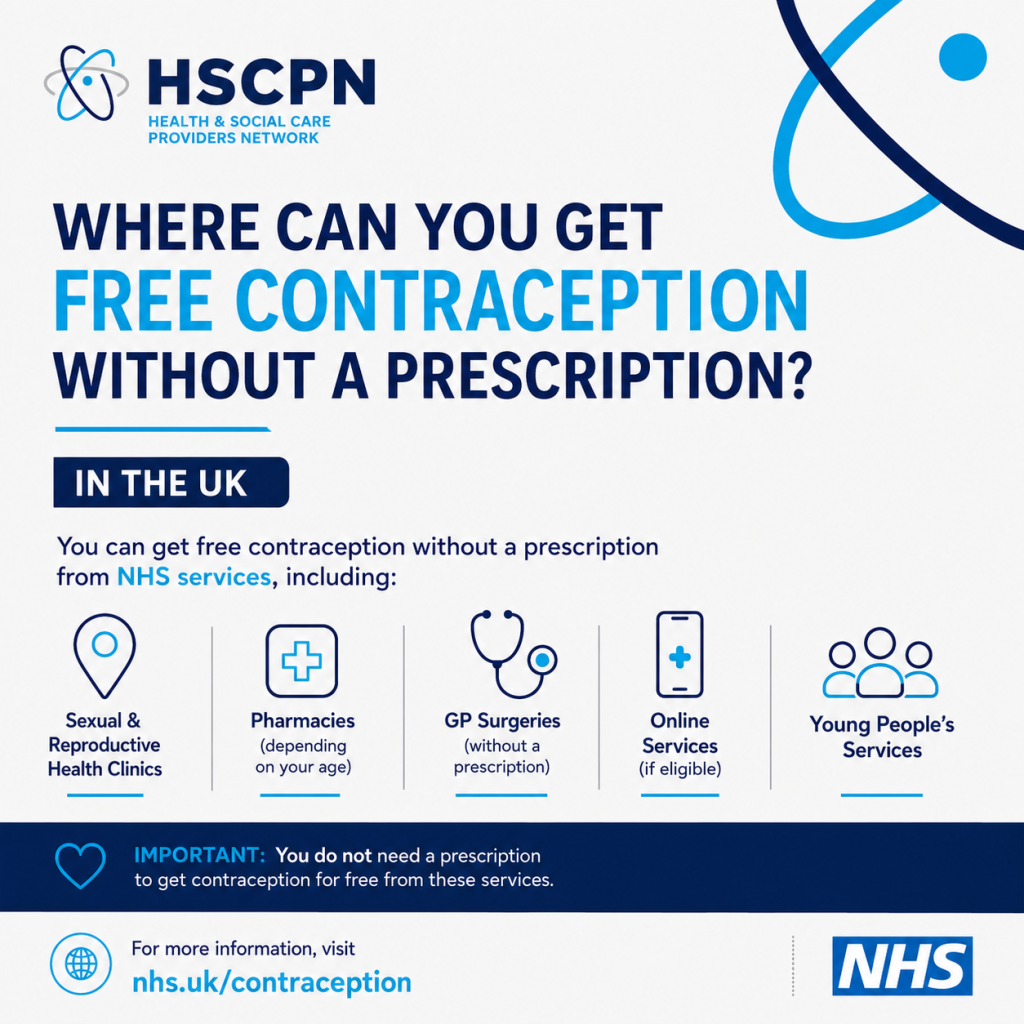
Where Can You Get Free Contraception?
The NHS provides several places where you can access contraception confidentially and, in most cases, without paying.
Sexual Health Clinics
Sexual Health Clinics offer a wide range of confidential services for people of all ages.
You can get:
- Contraceptive pills
- Implants
- Coils (IUD and IUS)
- Injections
- Condoms
- Emergency contraception
- STI testing
- Pregnancy testing
- Professional advice
You can easily find your nearest NHS Sexual Health Clinic using the NHS Service Finder.
GP Surgeries
Most GP surgeries provide free contraception as part of routine NHS healthcare.
Your GP can:
- Recommend the most suitable contraceptive
- Prescribe contraception
- Administer injections
- Refer you for implants or coils
- Discuss family planning
If you are not registered with a GP, you can find a GP near you using the NHS website.
Community Pharmacies
Many pharmacies now offer contraception through the NHS Pharmacy Contraception Service.
Depending on where you live, your local pharmacy may provide:
- Repeat oral contraception
- Emergency contraception
- Advice about contraception
- Referral to specialist services
This means you may not always need to make a GP appointment.
Online Sexual Health Services
Some NHS-funded services allow you to access contraception from home.
Depending on where you live, you may be able to:
- Order contraception online
- Request home STI testing kits
- Access emergency contraception
- Receive confidential advice
Trusted services such as SH:24 and Brook provide reliable information and online support for many people across the UK.
Free Condoms
Free condoms are available from many NHS-funded services, including:
- Sexual health clinics
- Some GP surgeries
- Participating pharmacies
- Colleges and universities
- Youth services
- Community organisations
Some areas also operate C-Card schemes, which allow eligible young people to collect free condoms confidentially.
What About Emergency Contraception?
If you’ve had unprotected sex or your contraception didn’t work, don’t panic.
Emergency contraception is available free from:
- Sexual health clinics
- Many pharmacies
- GP surgeries
- NHS walk-in services (where available)
It is most effective when used as soon as possible after unprotected sex, so don’t delay seeking advice.
If you’re unsure what to do, you can contact NHS 111 for confidential guidance.
Is It Confidential?
Yes.
One of the biggest concerns many people have is whether anyone else will find out.
The answer is no.
NHS contraception services are confidential. Healthcare professionals will not normally share your information with your parents, partner, employer or anyone else without your permission unless there is a serious safeguarding concern.
You can ask questions openly and receive advice without feeling judged.
Why Is Contraception Important?
Contraception is about more than preventing pregnancy.
It gives people the confidence and freedom to make informed decisions about their health, relationships and future.
Having access to contraception can help you:
✔ Prevent unplanned pregnancies
✔ Plan for the future
✔ Improve your reproductive health
✔ Reduce stress and uncertainty
✔ Access professional healthcare advice when you need it
Knowing your options allows you to make decisions that are right for you.
Which Contraceptive Method Is Right for You?
There is no single method that suits everyone.
Your choice may depend on:
- Your age
- Your general health
- Whether you want children in the future
- How often you have sex
- Whether you want protection against STIs
- How convenient you want your contraception to be
If you’re unsure, speak to a healthcare professional. They can explain the benefits, effectiveness and possible side effects of each option and help you choose the one that best fits your lifestyle.
Where Can You Learn More?
For trusted, evidence-based information, you can explore the NHS Contraception guidance.
If you’re looking for services near you, use the NHS Sexual Health Service Finder.
Healthcare professionals can also access clinical guidance from the Faculty of Sexual & Reproductive Healthcare (FSRH).
Young people may find additional support and advice through HSCPN Book Store and SH:24, both of which provide confidential information about sexual health and contraception.
Final Thoughts
Looking after your sexual health is an important part of looking after your overall wellbeing. Whether you’re considering contraception for the first time or thinking about changing your current method, help is available.
The NHS offers confidential, professional advice and a wide range of free contraception options, making it easier than ever to access the care you need. Don’t be afraid to ask questions, explore your choices and speak to a healthcare professional if you’re unsure. The right information can help you make confident decisions about your health and your future.